Accessing AI Value Earlier in the Lifecycle
Artificial intelligence is rapidly becoming foundational infrastructure for the global economy, but for most investors, meaningful exposure remains incomplete.
The reason is structural: much of AI’s value is being created in private markets, before companies ever reach public investors.
This is the gap strategies like the AIR Nova Fund are designed to address.
Private Markets Are Where AI Value Is Forming
The AI market is projected to grow from ~$244 billion in 2025 to ~$827 billion by 2030 (~28% CAGR)[1], with widespread enterprise adoption and significant capital flowing into infrastructure, computing, and applications. At the same time, leading technology companies are staying private longer—capturing more of their growth before public listing.
For investors relying solely on public equities, this creates a structural lag: participation typically occurs later in the lifecycle, often at higher valuations with less upside.
This dynamic is consistent with the well-known “J-curve” effect in private markets, where value creation occurs early in a company’s lifecycle but is not fully realized—or visible—until later stages. By the time companies reach public markets, much of the inflection in growth, repricing, and investor demand has already occurred.
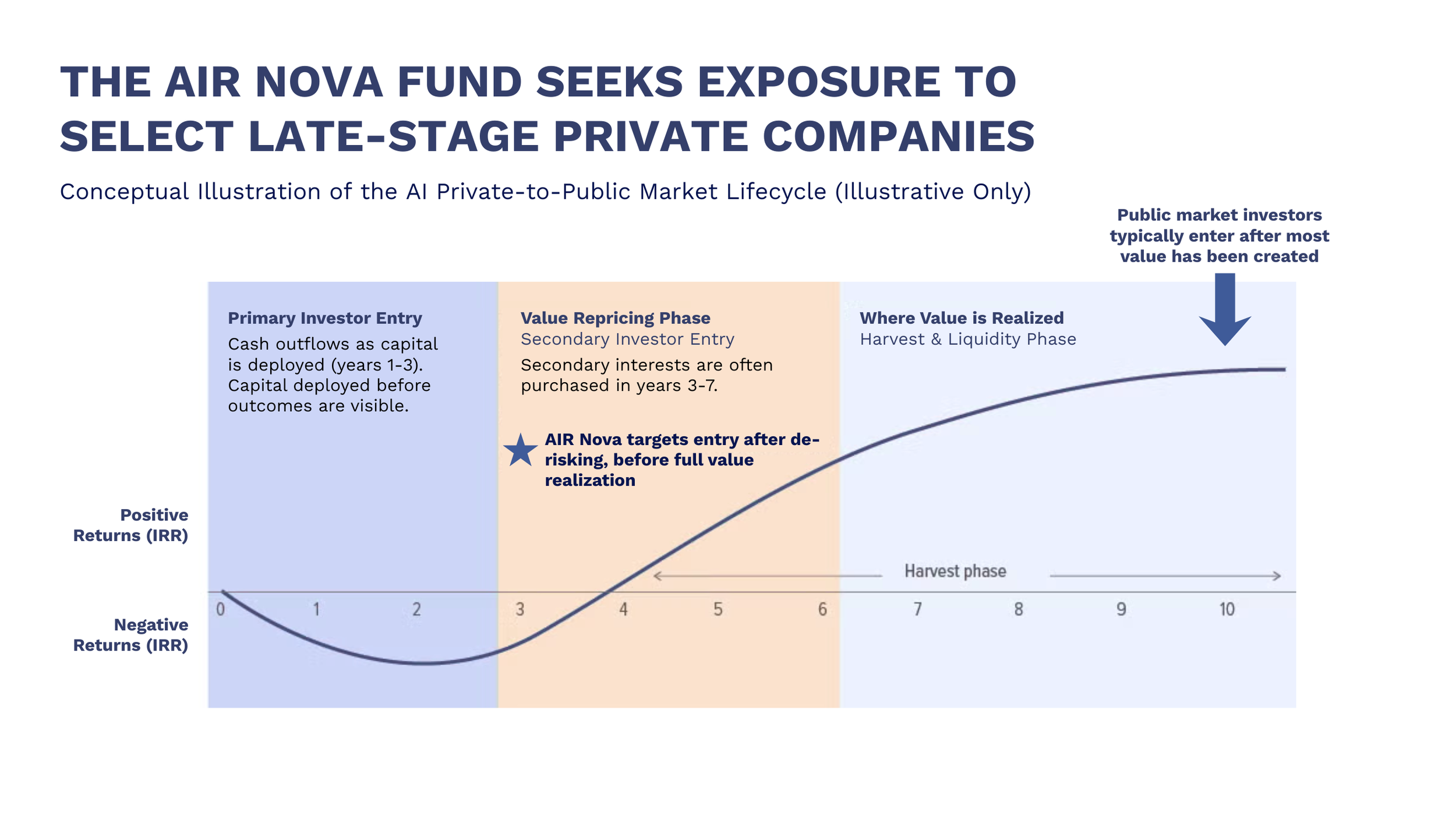
Source: AIR Asset Management. Not indicative of performance or timing. This is a hypothetical, conceptual illustration only. It does not reflect actual or expected performance, return patterns, volatility, drawdowns, or timing of investments or exits for AIR Nova Fund. No assurance can be given that the Fund will achieve any particular return profile, avoid losses at any stage, or experience liquidity within any timeframe. References to "primary," "secondary," "pre-IPO," or "public" are generalized market concepts and may not reflect actual opportunities available to the Fund. This illustration is hypothetical and conceptual in nature and does not reflect actual or expected Fund performance, probability of outcomes, or timing of investments or liquidity events.
The implication is clear: public markets tend to reflect outcomes, while private markets provide earlier exposure to the phase where value is actively being created and repriced.
The Access Problem in a Multi-Layered Ecosystem
Investor conviction in AI is high. Practical access is not.
As the J-curve illustrates, much of AI’s value creation occurs early—during the private market phase—while public market investors typically enter after key inflection points have already taken place.
Most traditional pathways reinforce this timing gap:
Public markets provide delayed exposure to value creation
Venture capital introduces long duration and blind-pool risk, with less visibility into timing and entry
Direct private investments remain fragmented and relationship-driven
The result is a structural mismatch: strong conviction in AI, but limited ability to access the phase where value is actively being created and repriced.
Part of the challenge is conceptual. Investors often approach AI through individual private transactions or broad public market exposure to technology. In reality, AI is a multi-layered ecosystem, with distinct drivers of value across the stack. Effective exposure to the ecosystem goes beyond isolated positions—combining targeted access to leading companies with diversification across private‑market sub-sectors, aligned with where capital is being deployed and repriced.
Understanding the AI Ecosystem
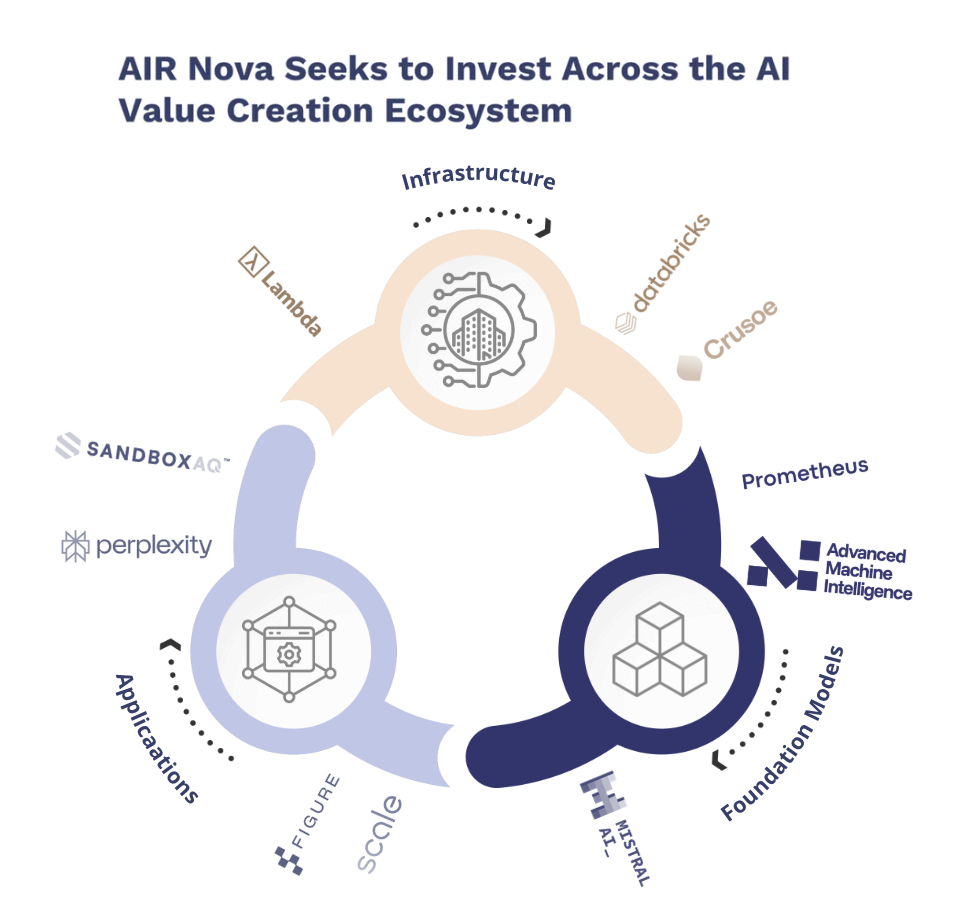
At a high level, the AI ecosystem can be understood across three interconnected layers:
Infrastructure: Compute, data, and systems enabling AI at scale
Foundation Models: The intelligence layer powering reasoning and decision-making
Applications: End-user and enterprise solutions translating capability into revenue
AI investment opportunities span multiple layers of the ecosystem, including infrastructure, models, and applications. These layers are interdependent, with advancements in one segment often supporting development in others. As a result, capital flows and competitive dynamics are observed across various parts of the ecosystem, rather than exclusively within a single segment.
This ecosystem is not theoretical—it is capital intensive and supply constrained. Global AI-related infrastructure investment is expected to reach $3–$8 trillion through 2030[2], with data center capacity, power consumption, and advanced compute still lagging demand.[3] Hyperscalers and governments are deploying capital on an unprecedented scale to close the gap.
For investors, this has two implications:
Accessing only public markets risks missing the early value-creation phase illustrated in the J-curve
Effective exposure requires a more flexible, multi-layered approach aligned with where capital is being deployed and repriced
AIR Nova’s portfolio construction is designed to reflect this reality. The strategy seeks selective exposure to leading companies across each layer of the value chain, including:
Infrastructure:
Lambda, Databricks, SandboxAQ
Foundation Models:
Perplexity, AMI Labs, Mistral AI
Applications:
Perplexity AI, Cursor, Scale AI
This approach reflects a simple but important insight: AI value creation is distributed, and capturing it requires both selectivity within each layer and flexibility across the ecosystem.
A More Complete Approach to AI Investing
Capturing the AI opportunity requires more than thematic exposure—it requires access to where value is actively forming, along with a disciplined approach to underwriting and portfolio construction. Meaningful AI exposure extends beyond thematic positioning, combining access to where value is forming with disciplined underwriting and portfolio construction.
The AIR Nova Fund is designed to provide institutional access to late-stage, pre-IPO AI companies operating across the AI ecosystem—targeting businesses that have moved beyond early-stage risk and are demonstrating traction, monetization, and proximity to liquidity. The strategy is focused on:
Secondary and structured opportunities where pricing inefficiencies may exist
Exposure to companies across key layers of the AI value chain, including infrastructure, models, and applications
A selective approach to underwriting in a market defined by rapid innovation and dispersion
Rather than relying on a single entry point, the strategy seeks to participate in the phase of the lifecycle where companies are scaling, capital is being repriced, and outcomes are not yet fully reflected in public markets.
Why Access Defines Outcomes
AI will reshape industries. That part is widely accepted.
What is less appreciated is how investors access AI may matter more than whether they believe in it.
Public and private markets often represent different stages along a company’s lifecycle, with private markets typically associated with earlier development and public markets reflecting more mature outcomes. The difference between the two is where a significant portion of value is created. AIR Nova Fund is built to bridge that gap—providing a more direct, diversified path into one of the most important investment themes of the next decade.
Sources:
[1] Gartner, “Worldwide AI Spending Forecast,” January 2026; McKinsey & Company, industry estimates.
[2] McKinsey & Company, “The Cost of Compute: A $7 Trillion Race to Scale Data Centers,” April 2025
[3] Utility Dive, December 2025; BloombergNEF estimates
Disclosures
This article is provided for informational purposes only and does not constitute an offer to sell or a solicitation of an offer to buy interests in AIR Nova Fund, LP (the “Fund”). Any such offer will be made solely through the Fund’s confidential private placement memorandum (“PPM”), subscription documents, and other governing materials, which should be reviewed carefully in their entirety before making any investment decision.
Investing in the Fund involves significant risks, including the potential loss of all or a substantial portion of invested capital. The Fund invests in private companies that are speculative, illiquid, and subject to substantial valuation uncertainty. There is no assurance that the Fund will achieve its investment objectives or that any investment will be profitable.
References to specific companies are provided for illustrative purposes only to demonstrate potential prospective investments and do not represent current holdings or any commitment to invest. Past experience of the Investment Manager does not guarantee future results. AIR Nova represents a new investment strategy and carries additional risks associated with limited performance history.
Any forward-looking statements are based on current expectations and assumptions and involve risks and uncertainties that may cause actual results to differ materially. Such statements are not guarantees of future performance. Any discussion of investment opportunities should be considered in light of these risks, which are significant and may result in loss of capital.
Pre-IPO and Liquidity Risk Disclosure
The Fund’s investment focus on “pre-IPO” companies refers to investments in privately held companies that have not yet completed an initial public offering (“IPO”) and may or may not ever pursue or complete an IPO. There can be no assurance that any portfolio company will complete an IPO, within any specific timeframe or at all.
Liquidity for investments in the Fund is expected to be realized through a variety of potential exit pathways, which may include IPOs, mergers or acquisitions, secondary sales, recapitalizations, or other strategic transactions. Such liquidity events are uncertain, may not occur, and may result in returns that differ materially from expectations. Investments in pre-IPO companies are inherently illiquid, speculative, and subject to significant valuation uncertainty.
No Performance Information; No Guarantees
This article does not contain performance information and should not be relied upon as a basis for evaluating the potential returns of the Fund. Past performance of the Investment Manager, its affiliates, or any related investment strategies is not indicative of future results. No assurance can be given that the Fund will achieve its investment objectives or that investors will receive a return of their capital.
Valuation and Market Data
Certain market data and industry information contained herein has been obtained from third-party sources believed to be reliable; however, no representation or warranty is made as to its accuracy or completeness. Valuations of private investments are inherently uncertain and may differ materially from values that would be realized upon disposition.
Investor Eligibility
Interests in the Fund are offered only to persons who are “Accredited Investors” and “Qualified Clients,” as such terms are defined under applicable U.S. securities laws. This article is not intended for use by any person to whom it would be unlawful to make such an offer or solicitation.
Governing Documents
In the event of any inconsistency between the information contained in this presentation and the Fund’s governing documents, including the PPM and limited partnership agreement, the governing documents shall control in all respects.