Building AIR Nova on a Decade of Institutional Discipline
Interest in private AI has never been higher — and neither has the number of ways to access it. Special purpose vehicles into individual AI companies are now widely available, often at minimums only marginally higher than a diversified fund. That raises a fair question for any prospective investor: why choose a fund vehicle over a direct bet on the company you believe will win?
Our answer starts with what we're not claiming. AIR Nova is not designed to protect investors from an AI slowdown. If AI as a category cools, the fund's exposure across foundation models, infrastructure, and applications will likely move together, not offset one another — these layers are connected parts of the same value chain, not independent risks. We think it's important to be direct about that, rather than overstate what diversification can do.
What Nova is built to solve is a narrower, more common problem: even investors with the right thesis get the company wrong. The foundation model that gets leapfrogged. The infrastructure provider that gets commoditized as the market standardizes. The application that gets replicated by the platform layer beneath it. That failure mode shows up inside winning themes as often as losing ones. Nova's structure exists to absorb it — spreading exposure across the AI value chain so that a single mispriced or out-competed name doesn't define the outcome.
That selection problem is also getting harder, not easier. In the first half of 2026, just two companies accounted for 43% of all global venture funding — among the highest concentrations in a pair of names in recent years, and part of a run that saw AI's overall share of global venture funding roughly double in a year. The chart below shows the trend.
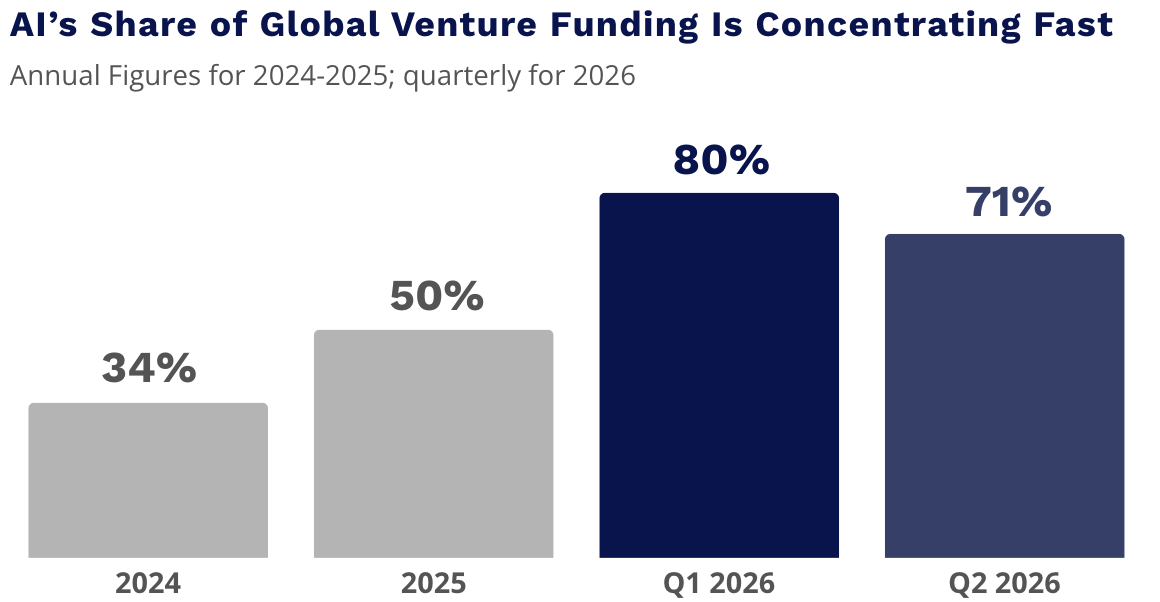
Source: Crunchbase data, as reported by Crunchbase News and Second Talent (Aug. 2026 compilation). Figures are approximate and provided for illustrative purposes only.
The practical effect: capital, and the access that comes with it, is concentrating into fewer doors. That's the environment Nova is built for — not to spread a bet across the category, but to be selective within it.
Purpose-built for AI, not appended to it.
Most late-stage secondary vehicles are generalist growth funds — a diversified sleeve of billion-dollar private companies across whatever sectors happen to be producing them this cycle, AI included alongside fintech, defense, and consumer names. Nova is built the other way: every position sits somewhere in the AI value chain, by design, not as one line among many. For an investor who wants exposure to this category specifically, rather than growth-stage private companies generally, that distinction is the point of the vehicle, not incidental to it.
Institutional infrastructure, not a startup.
AIR was founded in 2014 and has spent over a decade structuring, managing, and reporting on illiquid, long-duration private assets across life settlements, private credit, and legal finance. Nova is a new strategy for the firm, but it runs on infrastructure that isn't new: significant experience transacting secondary market contracts, institutional due diligence and structuring capabilities, and a team with decades of underwriting and investing experience across illiquid, complex assets.
Selective by design, not by default.
Most single-purpose AI vehicles are built around one access mode and effectively one decision: whether to buy the deal in front of them. Nova is built to choose. It can transact through direct secondary purchases, special purpose vehicles, forward and synthetic exposure structures, or interests in third-party funds — with the structure selected deal-by-deal based on what gets us into a specific company on terms that meet our underwriting criteria. Having more doors open is what lets us be selective about which ones we walk through, rather than taking what a single access point happens to offer.
A sourcing process built for where access is hardest.
AIR's sourcing partnership with Rainmaker Securities, combined with relationships we maintain directly across the AI value chain, is what puts Nova in a position to reach companies that don't come with obvious access points — the infrastructure and application-layer businesses operating underneath the names that make headlines. That sourcing capability is paired with an exit-side one: Rainmaker's business is transacting secondaries — sourcing sellers and placing exits on both sides of a deal — which means the relationship that gets Nova into a name also shapes how and when we get out of it if the opportunity presents itself. AIR brings its own decade of experience pricing and exiting illiquid positions across life settlements and private credit; paired with a partner whose core business is secondary transactions specifically, Nova isn't leaning on one side of that experience alone. It's also a potential mitigant to concentration risk. Nova still pursues the market leaders in each category we cover — that's by design, not an exception — but where sourcing reaches names beneath that headline layer, buying pressure concentrates far less than it does on the handful of logos every secondary desk is already chasing.
A partner built specifically for this market, not adjacent to it.
Rainmaker Securities is a FINRA-registered broker-dealer and SIPC member built specifically around the secondary market for late-stage private companies [1] — not a generalist bank that also does secondaries. Its leadership is a regular voice in the financial press on this market specifically: CEO Glen Anderson has appeared on Bloomberg Tech and in the Wall Street Journal discussing pre-IPO market conditions [2], including how IPOs such as CoreWeave and Figma have reshaped investor demand for AI-native private companies. In March 2026, Rainmaker launched the Rainmaker 20 Index [3], a proprietary benchmark tracking pricing trends across the late-stage private market — dedicated research infrastructure that informs Rainmaker’s sourcing activity.
Rainmaker's own disclosures describe a network of more than 60 registered representatives and deal flow spanning $50,000 SPV participations to $300 million-plus direct purchases [4].
Underwriting discipline built over a decade, applied to a new space.
AIR's investment team brings decades of combined experience in private equity, investment banking, and capital markets, developing underwriting for illiquid, information-constrained assets across the firm's existing strategies. Private AI secondaries are the newest place we're pointing that discipline, not a new discipline invented for the occasion.
For investors convinced of the AI thesis but unwilling to bet everything on picking the single right name, that's the case for a fund: not a guarantee against the category being wrong, but a structural approach to managing the risk of being right about AI and wrong about the company.
Sources:
[1] Rainmaker Securities, LLC — Firm overview and regulatory status, rainmakersecurities.com/crs and rainmakersecurities.com.
[2] “IPO Market Revs Back Up Ahead of Mega Listings,” Bloomberg Tech, April 27, 2026, as republished at rainmakersecurities.com/rainmaker-in-the-news/2026/4/27/ipo-market-revs-back-up-ahead-of-mega-listings.
[3] “Rainmaker Securities Launches the Rainmaker 20 Index, Advancing Transparency in Late-Stage Private Markets,” Business Wire, March 12, 2026.
[4] “Join Rainmaker Securities,” rainmakersecurities.com/investment-bankers, accessed August 2026.
Investing in the Fund involves significant risks, including the possible loss of all invested capital. The Fund has no operating or performance history. Prospective investors should carefully review the risk disclosures and Governing Documents before making any investment decision.
Disclosures:
No Offer or Solicitation; Investor Eligibility. This material does not constitute an offer to sell, or a solicitation of an offer to buy, interests in AIR Nova Fund LP (the "Fund"). Any such offer will be made solely through the Fund's Confidential Private Placement Memorandum ("PPM"), subscription documents and other governing materials (together, the "Governing Documents"), which should be reviewed carefully in their entirety before making any investment decision. Interests are offered pursuant to Rule 506(c) under the Securities Act of 1933 only to verified Accredited Investors who are also Qualified Clients; verification of accredited investor status is required prior to any investment. This material is not intended for use by any person to whom it would be unlawful to make such an offer or solicitation.
Testimonial and Endorsement Disclosure. The Materials feature statements by Glen Anderson, co-founder, CEO, and president of Rainmaker Securities, LLC ("Rainmaker"), a FINRA-registered broker-dealer and SIPC member. Mr. Anderson is not a current client or investor in the Fund. Rainmaker has a financial interest in promoting the Fund because increased fund assets and trading activity generate transaction revenue for Rainmaker. Mr. Anderson's statements regarding Rainmaker's capabilities, market depth, and pricing advantages should be evaluated in light of this conflict and should not be construed as independent, disinterested investment advice or as an endorsement of the Fund's future performance.
Placement Agent: Rainmaker Securities Data. Rainmaker Securities, LLC ("Rainmaker"), a FINRA-registered broker-dealer and SIPC member, is engaged on a non-exclusive basis as the Fund's placement agent and sourcing partner and is a compensated promoter of the Fund for purposes of Rule 206(4)-1 under the Investment Advisers Act of 1940 (the "Marketing Rule"). Rainmaker's compensation may include placement-agent commissions on subscriptions and/or transaction-based compensation on opportunities it introduces, creating conflicts of interest that are disclosed in the PPM and in this document; any placement fee borne by a referred investor is deducted on a fully disclosed basis and reduces the amount treated as invested. The material terms of Rainmaker's compensation arrangement, including the nature and approximate amount or formula of compensation, are disclosed to each prospective investor at or prior to the time of solicitation. The Firm's CEO holds an ownership interest in Rainmaker (the "CEO Interest"), which the Firm characterizes as de minimis and passive; Rainmaker is not an affiliate of the Investment Manager. The CEO Interest means that the CEO derives an indirect economic benefit when Rainmaker receives compensation from or in connection with the Fund, including placement-agent commissions and transaction-based compensation. This creates an additional conflict of interest: the Investment Manager's decision to select, retain and compensate Rainmaker was made with knowledge of the CEO's financial interest. The Investment Manager selected Rainmaker based on its regulatory standing, operating history, market infrastructure and sourcing capabilities, but prospective investors should consider that the CEO's personal financial interest existed at the time of selection and may have influenced that decision. Metrics relating to Rainmaker (including cumulative transaction value, transaction-volume growth and network size) are reported by Rainmaker, describe its brokerage activity across all of its clients, have not been independently verified by the Firm, and are not indicative of the Fund's access to any particular opportunity or of Fund performance. Rainmaker also serves as a sourcing partner that may introduce potential investment opportunities, and it may receive transaction-based compensation in connection with such introductions, which creates an incentive for Rainmaker to recommend transactions regardless of whether they are in the best interest of the Fund; this conflict is managed under the Firm's conflicts framework, Rainmaker's compensation terms are reviewed by the Chief Compliance Officer in light of the CEO Interest, and all investment decisions remain solely with the Investment Manager.
Risk of Loss; No Operating History. An investment in the Fund is speculative, illiquid and involves significant risk, including the possible loss of all or a substantial portion of invested capital. The Fund invests in private companies that are speculative, illiquid and subject to substantial valuation uncertainty. The Fund is newly established, has no operating or performance history, and represents a new investment strategy for the Firm, which carries additional risks associated with limited performance history. The Fund may invest in portfolio companies through special purpose vehicles ("SPVs") managed by third parties over which the Investment Manager has no control or limited governance rights; such SPVs may impose additional layers of fees, expenses and carried interest, and investors may have limited transparency into, or ability to influence, the management, operations or disposition decisions of those vehicles. There is no assurance that the Fund will achieve its investment objective or that any investment will be profitable.
Pre-IPO and Liquidity Risk. The Fund's focus on "pre-IPO" companies refers to investments in privately held companies that have not completed an initial public offering ("IPO") and may or may not ever pursue or complete an IPO. There can be no assurance that any portfolio company will complete an IPO, within any specific timeframe or at all. Liquidity is expected to be realized through a variety of potential exit pathways — which may include IPOs, mergers or acquisitions, secondary sales, recapitalizations or other strategic transactions — and such events are uncertain, may not occur, and may result in outcomes that differ materially from expectations. Positions may remain subject to lock-ups, transfer restrictions and issuer consents, including following a liquidity event. Investments held through third-party-managed SPVs or structured vehicles may be subject to additional liquidity constraints, including restrictions on transfer, lack of a secondary market for SPV interests, and dependence on the third-party manager's timeline and discretion for dispositions. The Fund is a closed-end vehicle with no investor redemption rights; investors should expect to hold their interests for the full term of the Fund, which may be extended, and should be prepared for the possibility that no liquid market for Fund interests will develop.
Counterparty Risk. The Fund is exposed to the credit and performance risk of its counterparties, including sellers of secondary interests, SPV sponsors and managers, forward-contract and synthetic-exposure counterparties, broker-dealers, placement agents, administrators and custodians. A counterparty's failure to perform its obligations — whether due to insolvency, fraud, operational failure, breach of contract or regulatory action — could result in financial loss to the Fund, delays in settlement or execution, inability to enforce contractual rights, or loss of access to investments or proceeds. Counterparty risk is heightened in secondary and structured transactions where the Fund may rely on representations, covenants or settlement commitments from parties over which it has no control and limited recourse. Where the Fund invests through third-party-managed SPVs, the Fund is additionally exposed to the operational, financial and compliance risk of the SPV manager, including the risk that the SPV manager mismanages the vehicle, fails to make required distributions, breaches its fiduciary or contractual duties, or becomes subject to insolvency or enforcement proceedings. The Investment Manager conducts counterparty due diligence and monitors exposures, but there can be no assurance that such measures will identify or prevent all counterparty-related losses.
Third-Party SPV Investments; Additional Expenses and Fees. The Fund may invest in portfolio companies through SPVs managed by third parties. Such third-party-managed SPVs may charge their own management fees, carried interest, performance compensation, organizational expenses, operating expenses, and transaction-related costs, which are in addition to — and not offset against — the Fund's own Management Fee and Carried Interest. As a result, the aggregate fees and expenses borne by an investor on capital allocated to third-party SPV positions may be materially higher than those applicable to direct investments, and such layered costs will reduce net returns to investors. The Fund has limited ability to negotiate or control the fee terms of third-party SPVs, and investors will generally not receive detailed fee-level transparency into those vehicles beyond what the Fund itself receives. In addition, the Fund may incur brokerage commissions, transfer taxes, legal fees associated with transfer documentation, and other transaction costs in connection with acquiring, holding and disposing of investments, all of which reduce net returns. Certain expenses — including those relating to non-consummated transactions ("broken-deal" costs) — are borne by the Fund regardless of whether an investment is completed.
No Performance Information; No Guarantees. This material does not contain performance information for the Fund and should not be relied upon as a basis for evaluating the Fund's potential returns. Past performance and past experience of the Investment Manager, its affiliates, its principals or any related investment strategies are not indicative of future results, and prior experience was obtained under different market conditions and technologies.
Market Data and Third-Party Information. Market data, industry statistics and other information derived from third-party sources are believed to be reliable but have not been independently verified; the Firm does not guarantee their accuracy, completeness or timeliness. Market data is provided for general industry context only and does not represent the size of any investment opportunity, capital deployment by the Fund, or any expectation of returns. Market trends, growth expectations and industry observations are based on current views and are subject to change; there is no assurance that such trends will continue or result in positive investment performance.
Forward-Looking Statements. Certain statements that are not historical fact constitute forward-looking statements, which are based on current expectations and assumptions and involve risks and uncertainties that may cause actual events or results to differ materially. Such statements are not guarantees of future performance, and the Firm undertakes no obligation to update them.
Governing Documents Control. The information in this material, including summaries of strategy, terms, fees, restrictions and economics, is qualified in its entirety by the Governing Documents. In the event of any inconsistency between this material and the Governing Documents, the Governing Documents control in all respects.
SEC Registration. Alternative Investment Resource, LLC (d/b/a AIR Asset Management) is registered with the Securities and Exchange Commission as an investment adviser. Such registration does not constitute an endorsement by the SEC nor does it indicate that the adviser has attained a particular level of skill or ability. The SEC has not approved or verified the contents of the Materials or the accuracy of any statements made herein. Investors should not interpret AIR's registration status as a recommendation or endorsement of the Fund, AIR's services, or any investment strategy described in the Materials.
Additional Information. For additional information about AIR, including its advisory services, fees, conflicts of interest, and disciplinary history, please refer to AIR's Form ADV Part 2A (the "Brochure"), available at www.adviserinfo.sec.gov.